Author: Cathy Dwyer

  • Is my Mac laptop sharing my location?

    how is this ZIP code being sent?

    Is my Mac laptop using cell tower information to calculate and transmit my location to third parties? I believe the answer is yes.

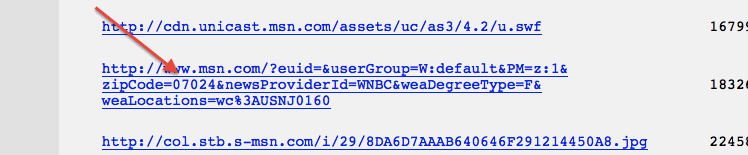
    Here is my evidence. I cleared recent history from Firefox, selected private browsing, then typed “Msn.com” into my browser. Then I looked at what was stored in my cache (using about:cache), and I found this entry (see above).

    This entry is a message from my browser to msn.com with whatever data can be passed along. Notice the “euid” field is empty. That is good, I am using private browsing. Then notice it is passing back my zip code as 07024, and my local news provider as WNBC. Is this coming from my IP address?

    The answer is no, it is coming from cell tower location information. How do I know this comes from cell tower rather than my IP address?

    The zip code transmitted is  07024 (Fort Lee, NJ). However I live right across the river is Washington Heights, upper Manhattan (below is the view of New Jersey from Washington Heights).  Often 911 calls via cell phone from my neighborhood get routed to New Jersey by mistake due to our close proximity to NJ cell towers. So my zip code is not coming from my IP address, which comes from Time Warner, hence it should be a NYC zip code, not a NJ zip code. It seems to be coming from cell tower triangulation, being collected and passed along by my Mac laptop :(

    View of New Jersey from Washington Heights
  • CSCW Workshop: Reconciling Privacy with Social Media

    CSCW Workshop: Reconciling Privacy with Social Media

    February 12, 2012

    Full Details: http://phitlab.host22.com/cscw2012privacyworkshop.html

    Call for Participation

    Much research on privacy in social media has focused on limiting personal information disclosure, increasing control, and perpetuating social withdrawal. Therefore, privacy goals are often characterized as diametrically opposed to goals of sharing and connecting via social media. However, privacy can also be characterized as a broader process where individuals and groups coordinate social interaction with others. In this broader conceptualization, privacy behavior moves beyond binary decisions to withhold or disclose and becomes an interactional process that involves the cooperation of others in the relationship. The goal of this workshop is to explore privacy in broader contexts and to understand its relationship to the benefits of social media and the support of online cooperative relationships.

    The workshop will focus on two main themes: Focusing on the benefits and outcomes of interactional privacy behaviors in social media environments, and emphasizing design and evaluation solutions for bringing such benefits to fruition.

    We invite potential workshop participants to submit 2-4 page position papers that describe research related to the workshop themes. The deadline for submission is November 25.

    Please see the workshop website at http://phitlab.host22.com/cscw2012privacyworkshop.html for more information.

    Workshop Co-Organizers:

    Heather Richter Lipford, University of North Carolina at Charlotte

    Pamela Wisniewski, University of North Carolina at Charlotte

    Cliff Lampe, University of Michigan

    Lorraine Kisselburgh, Purdue University

    Kelly Caine, Indiana University Bloomington

    Program Committee:

    Coye Cheshire, University of California Berkeley

    Catherine Dwyer, Pace University

    Woodrow Hartzog, Samford University

    Adam Joinson, University of Bath

    Jen King, University of California Berkeley

    Airi Lampinen, Helsinki Institute for Information Technology HIIT & University of Helsinki

    Deirdre Mulligan, University of California Berkeley

    Fred Stutzman, Carnegie Mellon University

    Janice Tsai, Microsoft

    Michael Zimmer, University of Wisconsin-Milwaukee

  • Elaborate tracking mechanisms revealed

    This summer Ayenson, Wambach, Soltani, Good and Hoofnagle and  published “Flash cookies and privacy II” on SSRN.

    The paper describes a number of technical mechanisms for persistent tracking of consumers.

    The paper was criticized by KissMetrics as inaccurate, and a response by Ashkan Soltani was posted here:

    http://ashkansoltani.org/docs/respawn_redux.html

  • When privacy harm has no economic value

    History sniffing lawsuit dismissed

    Recent privacy research has demonstrated the widespread collection of consumer browsing behavior by “history sniffing,” as well as by using flash cookies and ETags as tracking mechanisms. A lawsuit was dismissed in New York State when the plaintiff attempted a class action against history sniffing. The judge Deborah Batts ruled “Advertising on the Internet is no different from advertising on television or in newspapers … Even if [Sonal Bose, the plaintiff] took steps to prevent the data collection, her injury is still insufficient to meet the statutory threshold.”

    If collecting data without an individual’s consent causes a privacy harm, but that harm has no calculated economic value, then what has to change in order for laws to recognize data trespass as a legitimate harm?